
Generalist by Design, Not by Accident
Somewhere along the way, staying a generalist stopped being a phase and became the actual point.


The idea for this article has been in my backlog for 3 years now. It started with a simple question: As a software designer, what’s different about working at a software development agency compared to working in-house? Since the best way to answer this question is to experience both scenarios, I did exactly that.
But why make a comparison in the first place? When I was looking for answers to better understand the differences, there was very little content out there that I could relate to. Most articles are either focused on graphic design, branding, or written by agencies that are actually upselling to executives deciding whether to hire in-house or outsource.
This is not that. But this is also not a definitive guide, because it’s based on my personal experience doing product design at agencies with US-based clients and small in-house teams at startups.
3 years ago, I switched from agency to in-house with a strong hypothesis that building products would look different. I just didn’t know exactly how. Consider it a multi-year experiment, and this is the result of both experiences.
Doing a little bit of everything
I’ve shared in the past how my career started out as a graphic designer, which is a generalist path by design (not pun intended). During my bachelor’s degree, I studied a bit of everything, from history of design to composition, photography, multimedia, typography, and the list goes on. It allows students to get in touch with different applications of design, enough that it’ll slowly pull you in a certain direction of preference.
My freelance career in UI started during that time. Back then, I didn’t have any class adjacent to it, but I enjoyed it as a way of trying a different medium. I even thought it was going to be a temporary gig, but I enjoyed it because it allowed me to try different directions without a clear destination, and that’s a theme that kept following me in different ways throughout my career.
Fast, and everywhere at once
When it comes to software development at agencies, there are a lot of myths about how the design practice works, but there’s one thing that can’t be denied: the pacing is fast. Like, really fast.
On any given week, I would be working with up to 5 clients in parallel. All from different industries, all with different team compositions and different scopes. One of them might be close to launch, another might be a legacy app requiring a full revamp, and maybe a new client only has an idea and wants to see the v1 in 2 weeks. Or, as Peter Quill would say, “12% of a plan.” It’s barely a concept.
It goes without saying that executing design would look vastly different from client to client. The picture I just painted is an example of how 3 key skills were needed to thrive in this environment:
Prioritization, to manage every day and week efficiently.
Context switching, to adapt at every turn and understand what’s needed to keep moving.
Storytelling, because every client required a different narrative to collaborate and get buy-in from stakeholders.
Agency product design isn’t for the faint of heart, but if you’re willing to adapt, the reward is in the variety itself. Seeing a lot of 0 to 1, exploring many industries, and developing end-to-end skills that will come in handy anywhere else.
I spent those years debating how to specialize, because it seemed like I had to in order to have a successful career. I went through phases of focused learning in Design Systems, Business Design, and management. I could feel the pull from Design Systems, to the point that I pioneered this practice in El Salvador and it was already part of how people perceived me as a designer.
It could have seemed like a logical next chapter, but every time I seriously considered picking one path over the others, it felt like I was leaving another part of me behind.
When product calls for end-to-end
When I made the change to work at a startup, I expected that small teams would require end-to-end work, and eventually, I would focus on one of these paths. I just didn’t know how broad the end-to-end spectrum would get.
Since I already had experience as a generalist, my skills allowed me to support the team with anything from product, research, growth, web design, and Design Systems. Picking a single lane without a larger team would be a narrow perspective. Probably even individualistic, if I say so myself. But since I like being a team player, I was happy to wear many hats.
This became even more crucial when I joined onBeacon as a founding designer for an AI-native design tool. I didn’t have a clear idea of how my role would evolve, but my days and weeks are the most varied I have ever had in my career. To make a fair assessment, I asked Granola about which skills I’ve been using the most in the last 90 days, and the results are wild:
Context Engineering
Product Strategy & Positioning
Customer Research
Product Design
GTM & Pricing
And the list goes on...
My role demands constant range instead of a fixed lane. I thought I would be going deep instead of broad, but the challenges of a lean AI startup aren’t fit for a designer looking to specialize, because your impact should go far beyond the traditional boundaries of what design used to look like.
Mine certainly does, because some of my best contributions to the product can be found in the logic behind our context engineering and not in the UI. Turns out, this was the perfect Venn diagram of lived experiences, including many of the things I originally thought I would choose to specialize in while leaving the others behind.
It was never one or the other
People tend to box in generalism as a single mushy term. In the context of agency and in-house, I’ve come to view it as a matrix with two axes, and what changes is which axis you’re stretched across, not whether you’re stretched. Here’s what that looks like, with my own two chapters onto it.
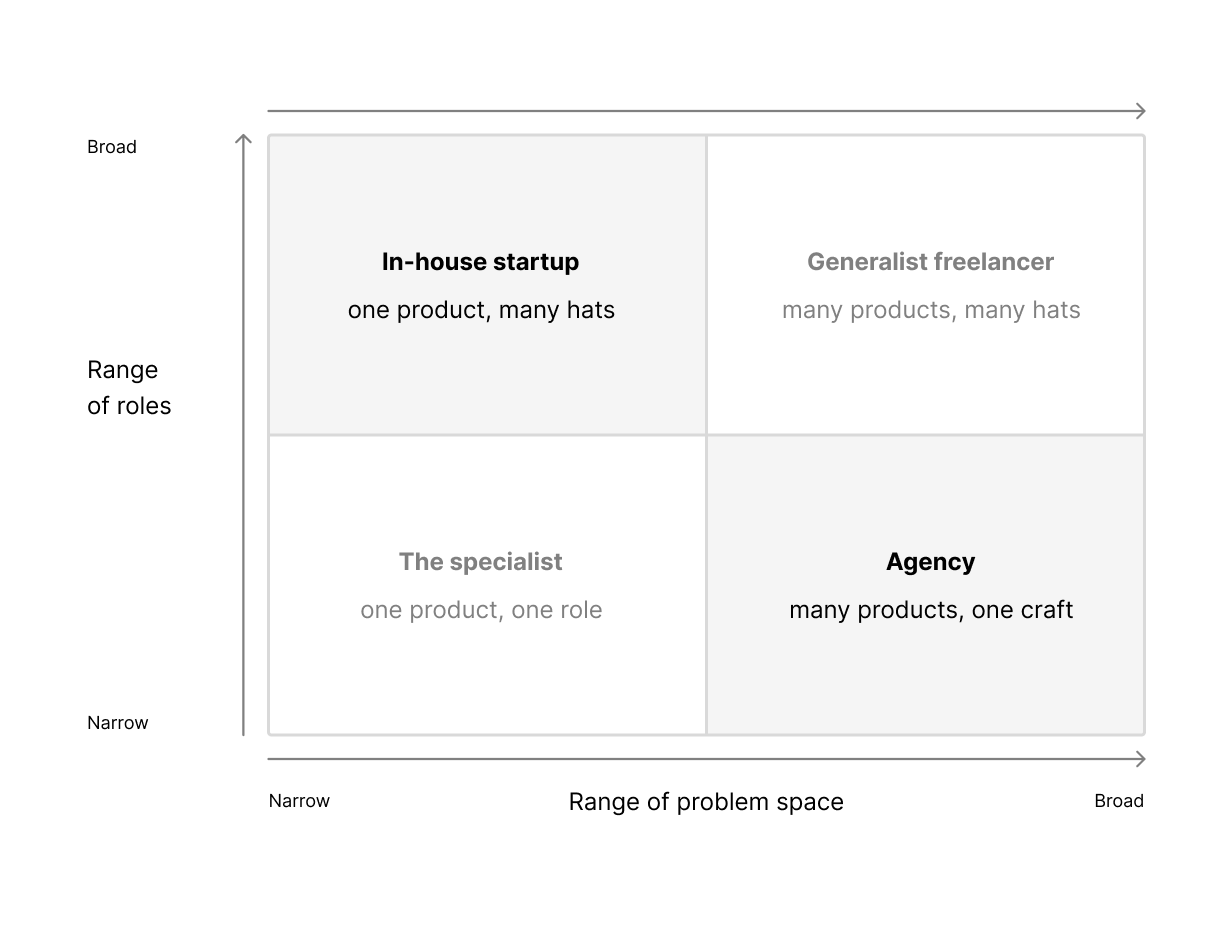
Agency demanded broad context, involving products and industries of all kinds. I used to tell juniors that every single client is different from the others for this very reason. It also means you can’t be certain of how long you’ll collaborate with a team, so you optimize for the highest impact in that specific stage of their product.
Product at a startup means owning one problem space long enough to live with the consequences of your decisions. But that depth doesn’t remove the range, it just moves it. Instead of stretching across five clients, I was stretching across five roles inside the one I had, as proven by the Granola list I shared, just aimed at a single target instead of many.
So, if you were to ask me 3 years ago how my role as a designer would look, I’m sure I would have said something completely different from what it is right now. But one thing’s for sure: the constant throughout this wild and unexpected journey has been a generalist mindset.
Parting thoughts
This is the point in the story where you’d expect me to say I’ve picked a path, but the reality is I’ve decided to embrace a non-linear career path instead. The answer was never intended to be a guide, because just like I went through different chapters in my career, you’ll notice your own patterns in yours.
If you’ve faced a similar debate in the past, it might actually be a sign, not a flaw, that you’re a generalist by nature. Roles like founding designer and design engineer exist because the industry needs more of this, not less.
Personally, I’ve decided to become a designer who builds, putting that mindset into the personal projects I always dreamed about but couldn’t materialize before. None of it existed 4 months ago. That’s how quickly things are changing, and possibly a sign of how quickly your own next chapter might start looking different too.
Shortcuts
The reinassance of the Visual Designer, as described by Ridd and Tommy Geoco at Dive Radio.
What companies look for when hiring Product Designers these days is a lot different than it used to, as observed by Tom Scott in his recruitment practice.
What design engineering is, how it’s changed, and where it’s going. There’s not a one-size-fits-all, and Marcelo Chaman helps to visualize this spectrum.
That’s where curiosity led me this month. Your path will look different, because context always matters.
If this sparked something, let’s continue the conversation on Twitter. And if someone you know is navigating their own creative uncertainty, share this their way.
Keep exploring,
Laura ✌️