
The Only Way Out Is Through
What happens when there's no one left to hand the problem to? Building solo, two products, and the quiet work of trusting yourself again.

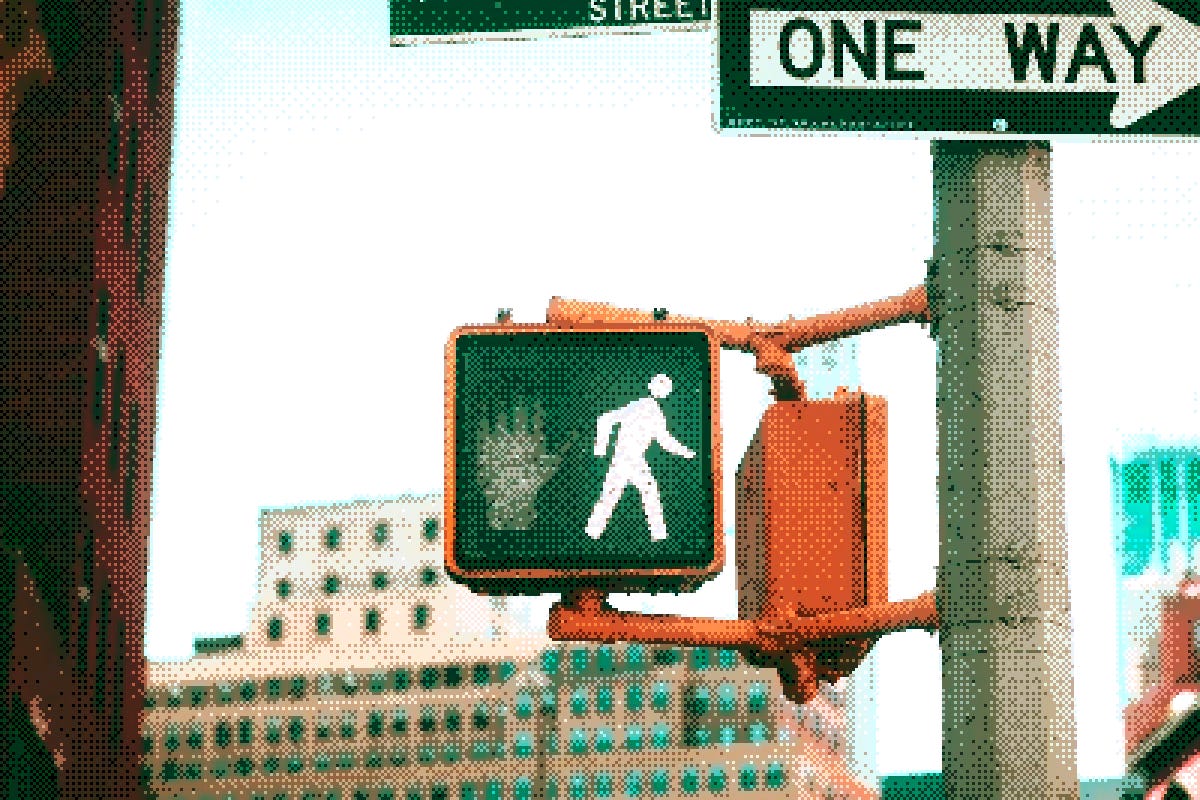
A lot of exciting product launches happened in June of 2026: Anthropic released Fable 5 and made a lot of headlines (in more ways than expected), Apple announced the revamp of Siri at WWDC that has me actually excited about updating my OS for the first time, and I launched my very first product, Flicker.
The idea didn’t happen overnight; it has been quietly building up for years. I’ve spent more time than I would like to admit hunting for the perfect loading spinner for each product I’ve worked on. Sometimes, I have an idea for the animation or pattern style, or imagine distinct spinners for certain events that could benefit from a bit of extra joy.
It’s always easier to just use the default option, but I like adding personality to the things I build. The thing is, finding good spinners isn’t an easy task, and it wasn’t easy to carve out the time to make something custom every time.
It wasn’t until I came across the Glyph Matrix on the Nothing Phone (2) in 2025 that I knew I wanted to do something as fun as that. It started with frame-by-frame in Figma, animated as an SVG with Make, and when the code landed in prod, I asked myself: “What if?”
The first spark
The first commit happened with v0 back in February, when the excitement of turning the frame-by-frame into a tool was still fresh. The main goal was simple: Doing these manually takes time, and I couldn’t easily control all the details at scale, so I wanted to systematize this process into a tool I could use to share spinners with engineers afterward.
Within the first session of planning, I landed on the core metaphor of the mechanical snap to match the actual flip-dot displays, the frame-by-frame animation with dot-painting process, and even the naming. It felt like a brain dump of excitement that needed some scoping and decent planning, but I could see it all working in my head.
Having the vision was the easy part. Making it real? It came through hurdles. A lot of them. But I wanted to be a doer, not just a talker, so it was time to take action.
What I hadn’t done before
Code and I aren’t complete strangers. I have dabbled in basic HTML and CSS in the past, learned a bit of Coffeescript to use in Framer Classic, and even animated in Flash using ActionScript. The one thing I hadn’t done was being the only one in the room when something broke unexpectedly. No team, no one to hand it over to, no “just wait for it to get fixed.” Just me, a bunch of LLM tools, and a deployment error I couldn’t figure out.
I thought I had momentum going, instructing v0 one prompt at a time what I wanted to build next, which led to a sudden database error. There’s an auto-fix option, so I handed my problem to the tool, which, after a few turns, managed to solve it. Minimal friction, but determined enough to continue.
A few days later, I encountered another error, and when v0 offered the “Fix with v0” option, I was happy to oblige. Only this time it turned into an unprompted full UI rollback, which happened twice in one sitting. I didn’t know whether the issue had been resolved or the build had simply been rolled back to a previous stable state, but I had hit a wall.
Were those unknown errors gone? What if another issue makes me go back to level 1? Do I have the patience to do it all over again?
Looking back at my logs, it was a mix of Next.js warnings and a routing bug that had me spinning my wheels. In hindsight, it was a trust problem in the tool and my ability to overcome unknown errors, not the bug itself, that made me step back.
There wasn’t a lack of ideas, but continuing meant risking the same loss again on terms I didn’t understand. Three months of quiet followed, and none of it was about motivation. I had to learn a different lesson to continue.
The wall was lower than I thought
Months later, something almost unrelated reopened the door.
I came across Kris Puckett’s course Neuma, with a simple framework: “You describe what you want, AI builds it.” This got my attention, because what do you mean I can just build anything by simply describing it? Didn’t I need more building experience and technical proficiency to start using the terminal?
One weekend afternoon, after finishing the first module of the course, I built a humble local HTML file using Claude Code and the terminal. Suddenly, the wall I’d been picturing, the idea that I needed more reps before I could be ready, turned out to be much lower than I thought. I’d already cleared it.
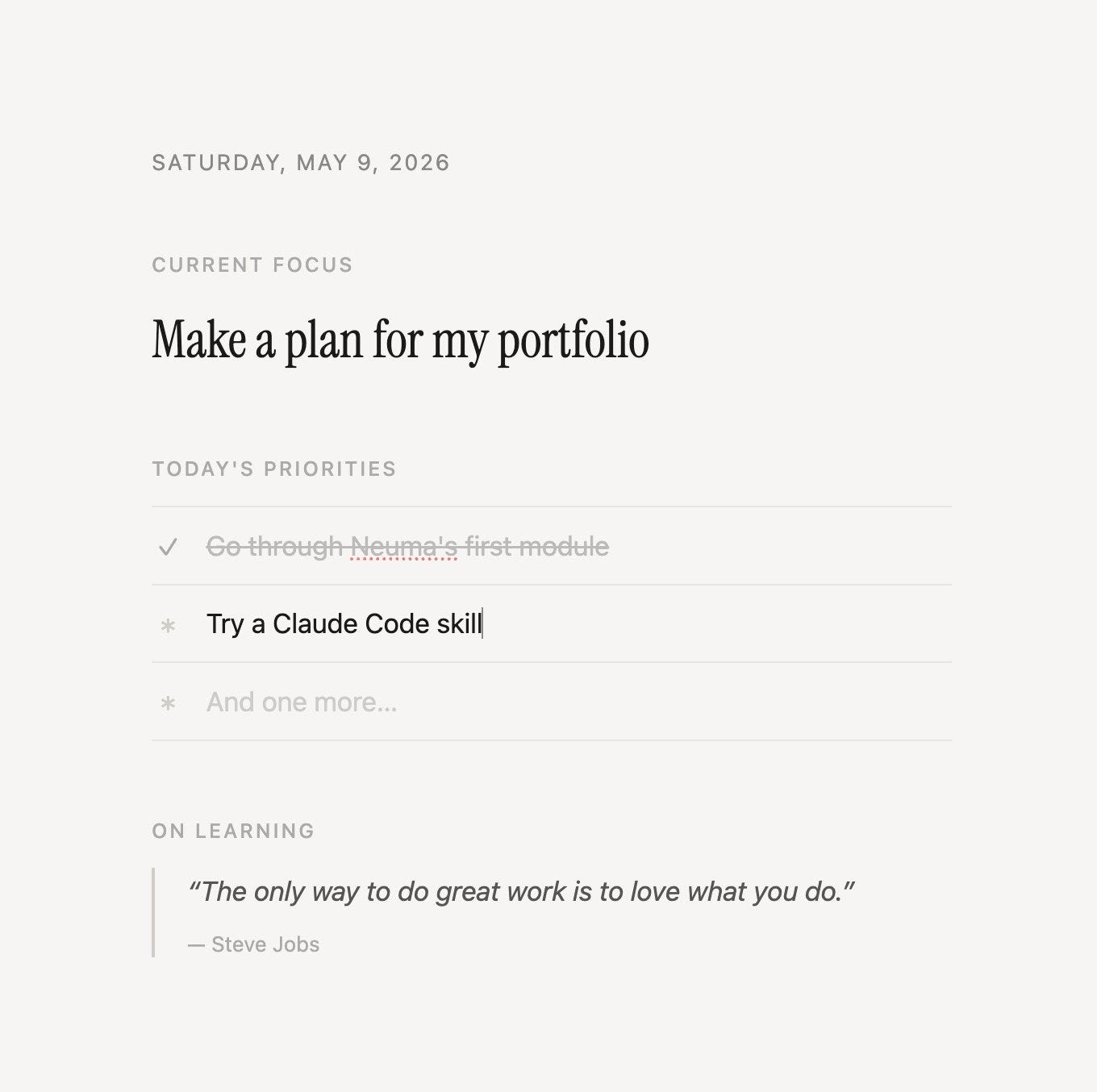
I was so excited I shared about it on Twitter, and the response was excitement in return. Even if the step felt small in that moment, I knew it was headed in the right direction.
Three days later, I came back to Flicker, but not the same way. I had reignited my confidence that I could bring ideas to life, and the work unfolded through planning before building and diagnosis before coding, with precise edits, one batch at a time.
Building a rhythm
What changed wasn’t my skill set, but rather the belief that I could navigate uncertainty on my own without knowing all the answers yet. That’s different from learning new tools.
Flicker became my playground for a month, testing new ideas and tinkering with new tools. Having a GitHub repo created with v0 and connected to Claude gave me a lot of control to look under the hood and diagnose various situations. On the other hand, I discovered a new way to explore ideas using skills in Claude Code, HTML artifacts, and tools like Variant UI. I could go on with the tools, but that belongs in another essay.
Dark mode and the color picker were both removed early, and then came back in a more stable build, like placing a puzzle piece in a clear space and waiting for it. The right things return when the foundation is ready for them.
The guest mode almost didn’t happen, but when I shared an early build with my sister, she made a very valid and yet simple question: What if people want to experience building a spinner? So I did a session purely on scoping how guest mode would work without requiring authentication.
The biggest mindset change was realizing that whenever I felt frustrated, I had to pause to make a decision: Is there a new concept I should learn? Is it time to pivot and use a different approach? Or am I simply running low on battery and need to end the session to come back refreshed the next day?
Through plenty of lessons and frustrations, principles began to emerge and compound, making the next build better. And it did indeed, as you’ll see in a bit. It wasn’t a single prompt or a single tool. It was hundreds of small decisions that happened along the way.
Building Flicker felt like a sprint. It happened late at night and during weekends, which wasn’t easy, but the outcome made it worth it. I launched on June 8th, and the response has been overwhelmingly positive, with the most common adjective being “fun.” Is it useful? Check. Is it fun? Check again. The real test came two weeks later during Config, and the outcome was way better than I imagined.


Parting thoughts
Earlier this year, I wrote how I wanted to share how I build, not just the way I think. The path looked nothing like I had planned, but the intention held. The best proof would be Zone Camera, which I rebuilt from the ground up in two weeks and launched it the same week of Config. The experiment I shared over a year ago is now fully created the way I originally intended. I was developing my ideas with Flicker, and I did it again with Zone, but faster, without the three-month gap.


Through both projects, I realized that not knowing isn’t the same as lacking judgment. Just because I don’t know the answer yet doesn’t mean I can’t build it. So I used my curiosity, thinking through each problem to make my intent clear, and paying attention to the moments when a pause was the best move, rather than brute-forcing features with vibe-prompting alone. Lesson learned.
The quality of the conversations I had during Config has been the biggest reward of all. My conversations were no longer hypothetical or purely about discussing AI in the context of the day-to-day work. I was putting in the reps, so I could relate to the workflows, ways of working, and struggles that others were sharing. Furthermore, the first spinner created with Flicker is now in the wild, and Zone Camera was even mistaken for the (Not Boring) Camera for a brief moment, and this is probably the biggest compliment I could ever ask for.
“The future belongs to designers who build.”
— Soleio
For the first time in my career, I sensed a shift in how I viewed my list of ideas: I could now build them.
You can play with Flicker to create a flip-dot loading spinner, or capture dithered memories with Zone Camera. But more importantly: build your ideas. The confidence gap doesn’t close on its own or happen by reading about it. The only way to discover you can own something end-to-end is to finish it. The only way out is indeed through. It felt right before, and still is now that I’ve gone through it.
That’s where curiosity led me this month. Your path will look different, because context always matters.
If this sparked something, let’s continue the conversation on Twitter. And if someone you know is navigating their own creative uncertainty, share this their way.
Keep exploring,
Laura ✌️