
There's No Such Thing as Perfect Process
Process was never the point. Three designers who figured that out, and what they're doing instead.


Believe it or not, this topic has been on my writing backlog since September of 2024. Had this been written back then, the output would’ve looked wildly different. Initially, I wanted to share my new process compared to the one I used at software development agencies. Now, it’s a whole different story. I was already skeptical back then about the idea of a perfect process, but the tooling and the ways of working have changed much more in the time that has passed.
On the tooling side, articles and hot takes claiming that the canvas is dead have been piling up nonstop. Shortsighted, if you ask me. But lines are blurring faster than ever, and if I look at my own tasks from last week, I’m doing work I wouldn’t have imagined before AI happened. The how, where, and why it changes a designer’s workflow is still, as usual, something that depends.
Today, I want to share 3 examples of designers who aren’t afraid to experiment for better outcomes, rather than blindly following processes.
Don’t trust the process
Remember when design was all about the process? This mindset pushed an entire generation of designers into thinking that following cookie-cutter steps was necessary to arrive at the perfect solution, instead of understanding the problem with critical thinking.
Jenny Wen’s essay and her talk at the Hatch Conference make the case that many of us were afraid to realize: at some point, “trusting the process” became about output artifacts rather than about the people living these experiences.
Portfolios filled with journey maps, personas, and user flows. Proof of process rather than proof of craft. We spent so much energy decoding users through artifacts that we stopped making things people actually loved to use.
Memorize every step.
Fill in every box of the template.
All portfolios looked the same.
Designers and the tech industry in general were due for a reality check, because AI has inevitably disrupted everything we thought we knew about design practice before. Roles are blurring faster than ever. Doing more with smaller teams. The tooling landscape is changing almost every month.
The one-size-fits-all kind of process is outdated now, because when everyone can generate options effortlessly, what truly matters is selection. Not generating more, but choosing better. Curating and using your judgment with confidence. This is why Jenny’s examples of how great work is made can be applied in the new reality we live in, favoring end experiences over artifacts:
Starting from the solution instead of the problem statement. Caring ruthlessly about details. Operating on intuition built through deep user understanding. Skipping steps, backtracking, changing things after handoff. Making something just for the sake of making people smile. It’s messy, and as Jenny puts it, she wouldn’t have it any other way.
I keep coming back to these approaches because they align with the messy, unpredictable context in which I’ve been working for the last 2 years as a founding designer at an AI-native startup. Now more than ever, we need to adapt and build our internal model to make decisions faster. That’s exactly where I’m at right now, trying to move from “what’s the right process?” to “what feels right for this moment?”
“Your value as a designer is in honing that process to get to the best results, not following one”
— Jenny Wen
The bad build is the point
For the longest time, I thought ideation required structure and planning upfront. Turns out, I just lacked the right tools. I can gather unstructured thoughts and context materials, diving deeper to truly understand the problem. That’s one of the ways in which Tom Johnson’s work has changed, sometimes even dumping transcripts into Claude with little to no structure.
Then comes the part that’s all about building a structure that works, but looks terrible. For designers who keep a high bar of quality, this can feel counterintuitive. Almost like a waste of time. That is, until you realize what the actual intent is. What Tom calls the “bad build” is focused on function first, creative direction second. Defining interactions, information architecture, and systems thinking, all without worrying about the styling. And when that is ready, you can act as a curator, without having to paint on a blank canvas.
Voice, rough-edged builds, the canvas, and even hand-made wireframes are all different mediums that will shine if used in the right moment. Sometimes it comes in a conversation, your own scattered thoughts, or your mental repository of the visual language you’re trying to create.
These days, I know I can come up with wild ideas mid-conversation and actually keep them. I never expected to be throwing a Loki reference while pitching a feature in its early stages, but that’s exactly what happened this week. I painted the picture, and Granola had it neatly structured in my notes in a matter of seconds. With MCP support now live, those notes are worth even more.
Embracing dynamic workflows means you understand where AI can give you a head start, and when your own judgment is most valuable. Leverage the right tool to capture intent as easily as possible, with the least amount of friction possible. As Tom likes to put it: it’s about exploring solutions, making things up, and finding flow.
I’m not sure how long this workflow will continue. The tools may change, the process may change, the amount of complexity may change. But when I look at it detailed out, it’s still design.
It’s still a process of exploring different solutions.
Of making things up and finding flow.
The difference is what tools, and the order they are used.
— Tom Johnson
Explore first, seeking signal from noise, until the path forward is clear.
Two questions, every tool decision
What I find most interesting about Ridd’s approach to choosing AI coding tools is the premise underneath it: each tool serves a different purpose depending on your intent, rather than trying to fit a single workflow for every situation. When he mentioned during our conversation on craft that every piece of work can be mapped to a 2x2 matrix, I knew he wasn't joking, because his latest matrix clicked for me immediately.
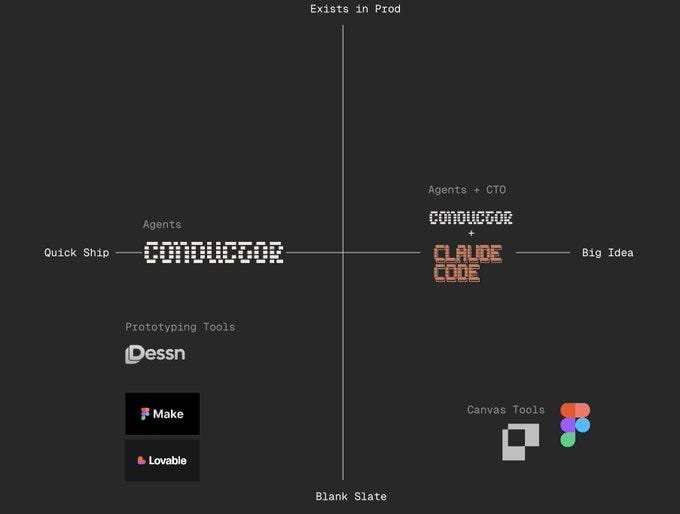
While many people are debating about whether or not designers should stay in a canvas or fully embrace code, his approach is very pragmatic:
Blank slate
Bottom left and right quadrants
Starting from scratch? Pick your favorite prototype tool, like Lovable, v0, or Figma Make. These tools leverage out-of-the-box libraries that are well-crafted already, like Tailwind and Shadcn. The trap that Ridd reminds all of us is to avoid rebuilding too much, and I’ve been guilty of that as well. Focus on interaction, with just enough quality to convey your idea.
Do you have materials in Figma? Copy/paste it to Figma Make, it’ll do wonders to leverage your existing library, layout, and content, so all you have to do is use natural language to prompt interactions and new functionality. You can even go back to Figma, tweak small details, and bring it back to Make again, which is how Ridd did this prototype.
Exists in prod
Top left and right quadrants
Small scope? Grab your CLI tool of choice, like Cursor or Claude Code. The main goal is to go from UI fix to PR and merge as easy as possible. This is a workflow I haven’t personally explored yet, but when I do, I’ll be taking Conductor out for a spin.
Big ideas? Once again, grab a CLI and leverage plan mode. Since planning and executing are two distinct mental models, doing it all at the same time can be frustrating, time-consuming, and spend way more tokens than your average AI tool bill.
My entry point into this was Ryan Rumsey’s process, where he literally prompts Claude to act as his CTO to drive the development plan and flag fixes along the way. That framing clicked for me, and it lines up with how Ridd thinks about it too. From there, treating the AI as a collaborator with a role rather than a clipboard changed how I approached building. And since the AI tooling space moves at the speed of light, Vercel shipped planning mode and better GitHub integration for v0 basically while I was still writing this. Way to go Vercel team!
If you’re wondering about prototyping and building workflows, take a look at his walkthrough, where he shares many examples and his thinking behind each use case. Worth a watch!
Parting thoughts
Tom, Ridd, and Jenny arrived at very different workflows. None of them got there by following a template.
They got there by staying curious, noticing what wasn’t working, and being willing to try something else. That’s not a process. It’s a practice. And the difference matters: a process is something you follow, a practice is something you build.
Three years ago, I wouldn’t have guessed I’d be writing system prompts, running evals, or making judgment calls on model outputs as a core part of my design practice. None of that was in a job description. It just became what the work required, and I followed it. Discomfort has a funny way of becoming your competitive advantage when you stop fighting it.
Nobody’s workflow is going to look like yours, because nobody else has your context, your constraints, or your way of making sense of a problem. The tooling will keep changing. What won’t is the value of knowing when to adapt.
The most dangerous thing you can do right now is treat someone else’s process as the answer. The most useful thing is to stay curious about your own.
Shortcuts
Three Modes of Working with AI: Create, Understand, Act, written by Stefan Klocek, to differentiate the intent behind each mode and how to support it.
Case Study Factory, by Fabricio Texeira and Caio Braga, with a message that's still relevant almost 7 years after being first published.
Taste is selection, as Soleio illustrates, with our environment selecting as much as we do.
That’s where curiosity led me this month. Your path will look different, because context always matters.
If this sparked something, let’s continue the conversation on Twitter. And if someone you know is navigating their own creative uncertainty, share this their way.
Keep exploring, Laura ✌️